For apartment communities — and for your own events
Plan less. Celebrate more.
Your community’s festivals — the collection, the schedule, the volunteers, the
accounts — in one place instead of eleven WhatsApp threads and a notebook.
And whatever you are hosting yourself on Saturday.
Free for your community. Forever. Not a trial, not a tier.
We never touch your money. Residents pay by UPI straight into your
society’s own account. We write down what happened. That is all.
1024 flats. One WhatsApp group. And a treasurer with a notebook.
“Has B-404 paid?”
Scroll up through 300 messages. Six people paid by UPI, four gave cash to a block
lead, one says he paid and it is not written anywhere.
“Who is doing the prasadam?”
Somebody said they would. Nobody is sure who, and the person who knows is not in
this group.
“Where did the money go?”
Asked in October, about a festival in September, by someone who was not on the
committee. Nobody can answer it properly, and that is how the arguments start.
What it does
Three things, properly.
Collect without ever handling the money
Residents tap once and their own UPI app opens, paid into your society’s account.
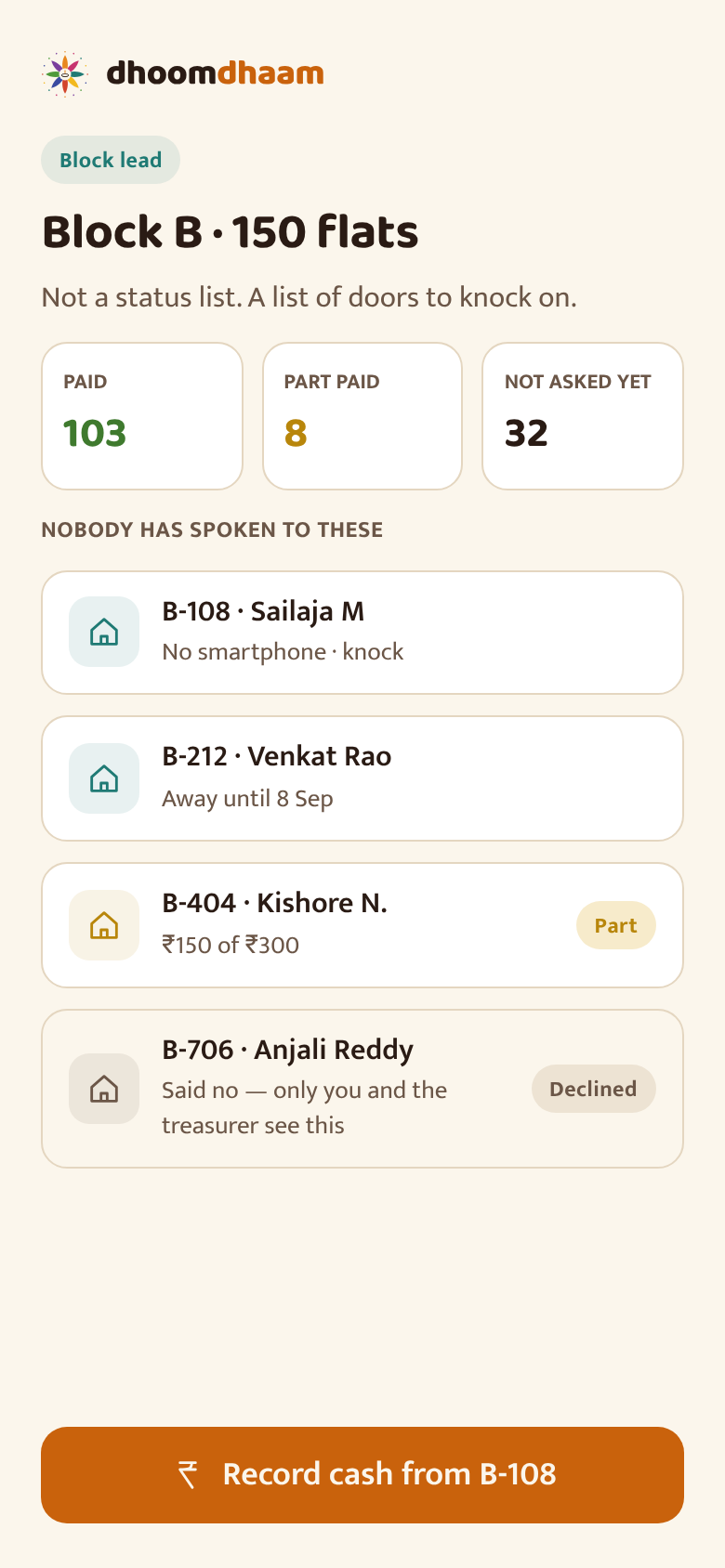
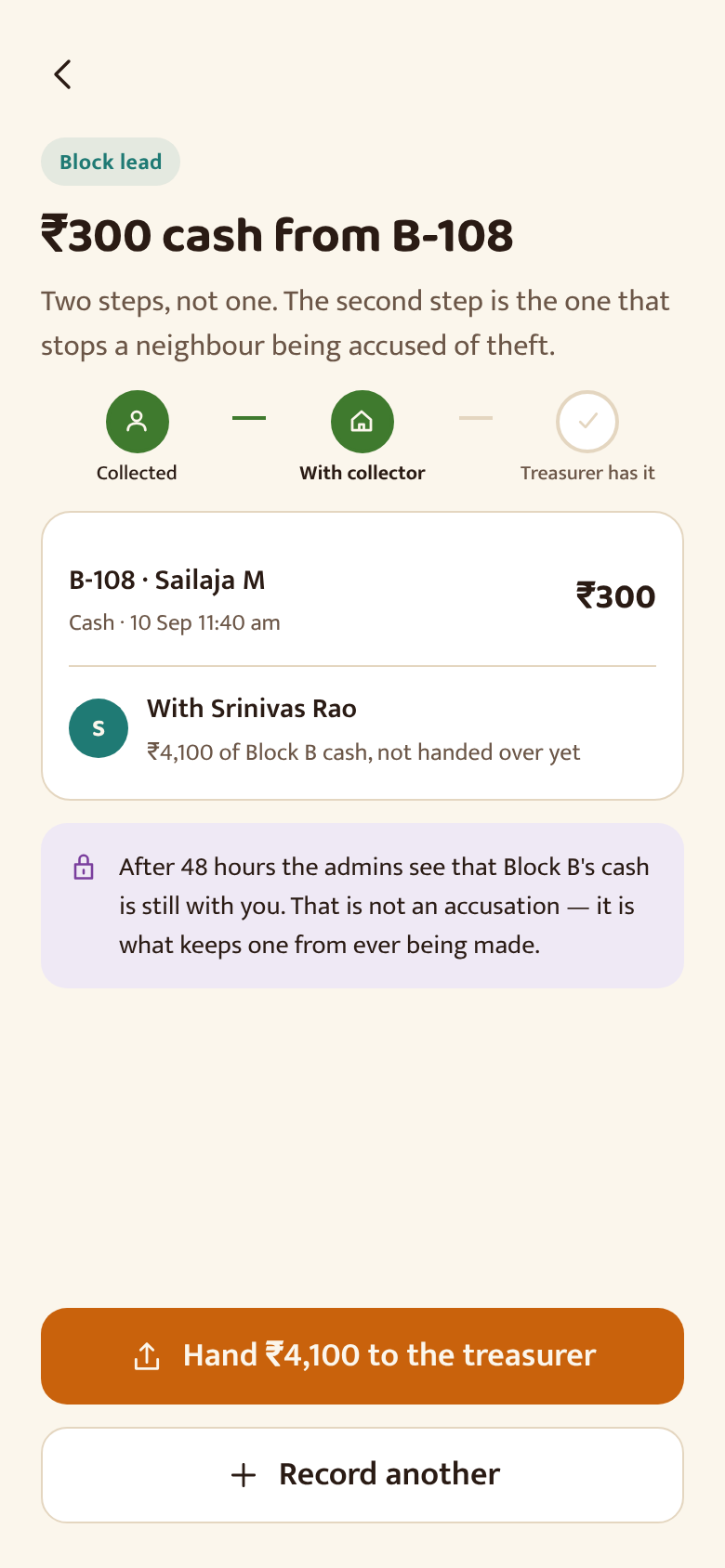
Block leads record cash for the homes that have no smartphone — and cash is tracked in
two steps, so everyone can see it moved from the collector to the treasurer.
Part payments, declined, exempt — not just paid and pending
Who has not paid is private. Only they, their block lead and the treasurer see it
“I paid, it says pending” goes to the treasurer with a screenshot, not to the group
Everybody knows what they are doing
A festival lead hands out the days. Organisers accept or decline — nobody is an owner
because somebody typed their name. Three days out, every owner says
ready or here is my problem, and silence shows as a problem too.
Pre-filled from last year, down to your own timings and vendor names
One tap tells 1024 homes the arati is running late
Volunteers sign themselves up for serving shifts
All of it, not the easy parts
Your Ganapati. Not a generic event.
Every screen opens already filled in from last year — your timings, your vendors,
your sports — and you can change any of it. Nothing here was invented by someone
who has not stood at a pandal at eleven at night.
The eleven days
Aagman — the arrival, the dhol, the sthapana puja
Morning and evening pujas residents book a slot for, with a cap per home
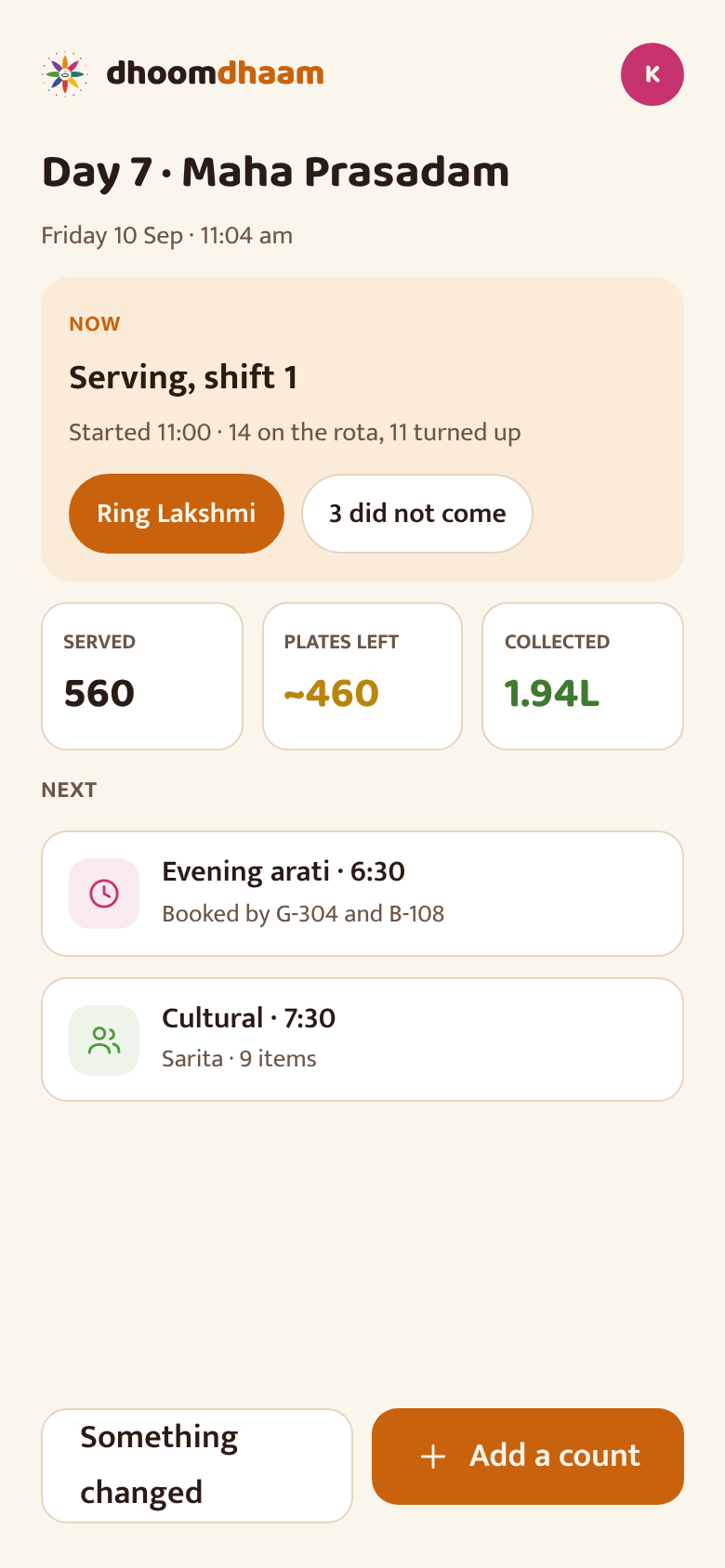
Daily prasadam, counted
Maha Prasadam, with a serving rota across shifts and kitchens
Cultural evenings, run by whoever you hand them to
Nimajjan — the procession, the pond slot, the sound cutoff
The money, all of it
Per-flat amounts — fixed, open, or none at all
Cash, tracked from the collector to the treasurer
Donations above the amount, named or anonymous
Laddu and Patu Vastralu auctions, with who owes what by when
Advances paid out of an organiser’s own pocket
Reimbursement claims with a photo of the bill
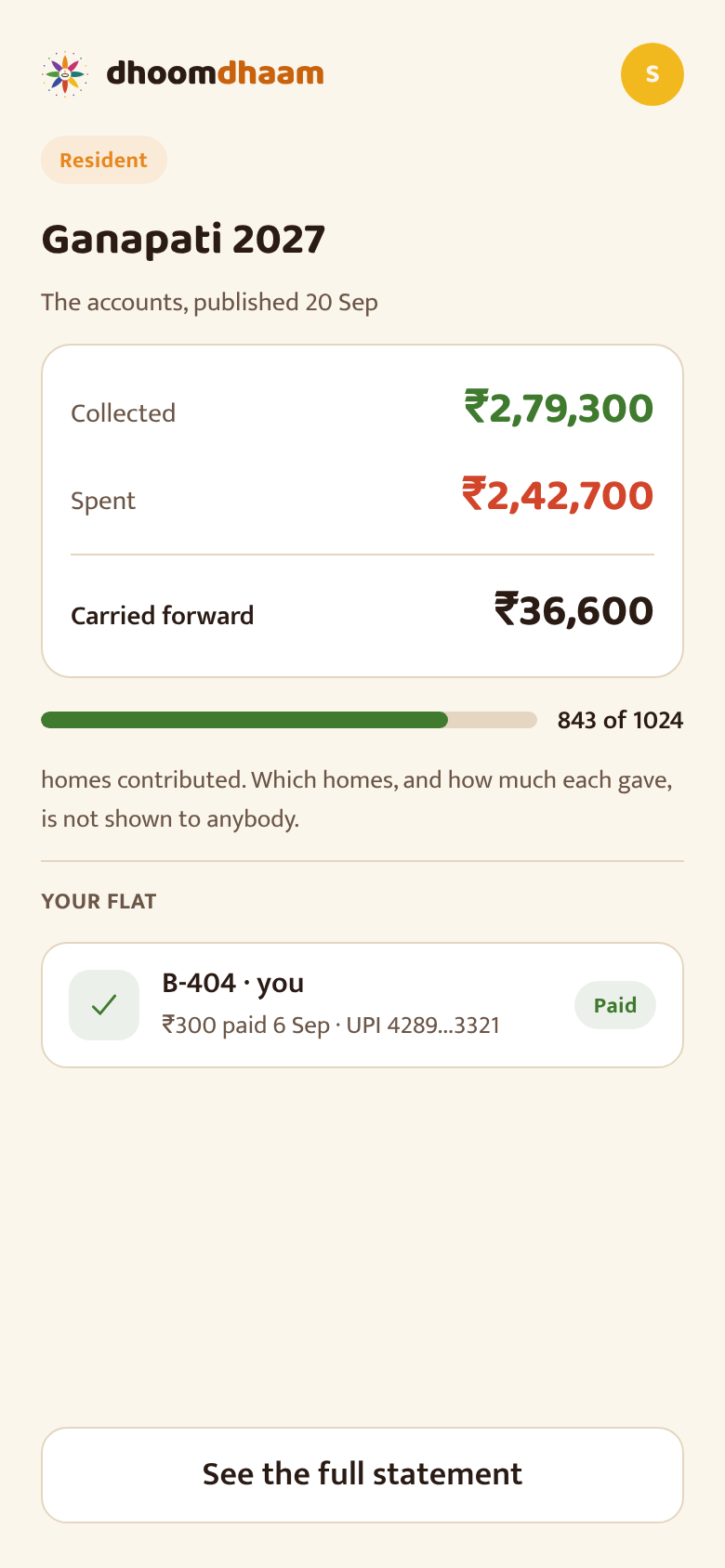
One page of accounts, sent to every home
The people
A festival lead, handed the whole thing by an admin
Organisers who have to accept before they count as owners
A block lead for each block, confirming their own neighbours
Volunteers who sign themselves up for shifts
A readiness check three days out, where silence reads red
Two admins for anything touching money or power
Sports
Carrom, cricket, throwball, chess, musical chairs — add your own
Registration with a cap, and categories by age or by ladies and gents
Matches on dates outside the festival, which is how it actually works
The draw sheet you made by hand, photographed and shared
Everything to arrange
The task list — tent house, flowers, oil, generator, the pandit
Quotations from different vendors, compared side by side
Why you picked the one you picked, if it was not the cheapest
Who paid the advance, and who is still owed
What was quoted against what was actually paid
On the day
What is happening now, and who is on duty, with their numbers
One tap to say the arati is running late
Plates served, and how many homes are still to come
Two lines at the end of each day, so the accounts write themselves
The part that matters
One page, sent to every home.
When the festival closes, the ledger locks and this goes out. What came in, what went
out, what is left and who decided what happens to it — with both admins’ names on it.
Every correction is a new line, never an edit. Four months later you can still show
exactly what happened and who did it. That is the whole point.
Not one weekend a year
Nine festivals, and the months in between.
JanSankranti
MarHoli
MarUgadi
SepGanapati
OctBathukamma
OctNavratri
OctDiwali
NovKarthika Deepotsavam
DecChristmas & New Year
Each one set up once and copied forward the next year. Add whatever your community
keeps that is not on this list — the vocabulary is yours, not ours.
Not only the big festivals
And whatever you are hosting on Saturday.
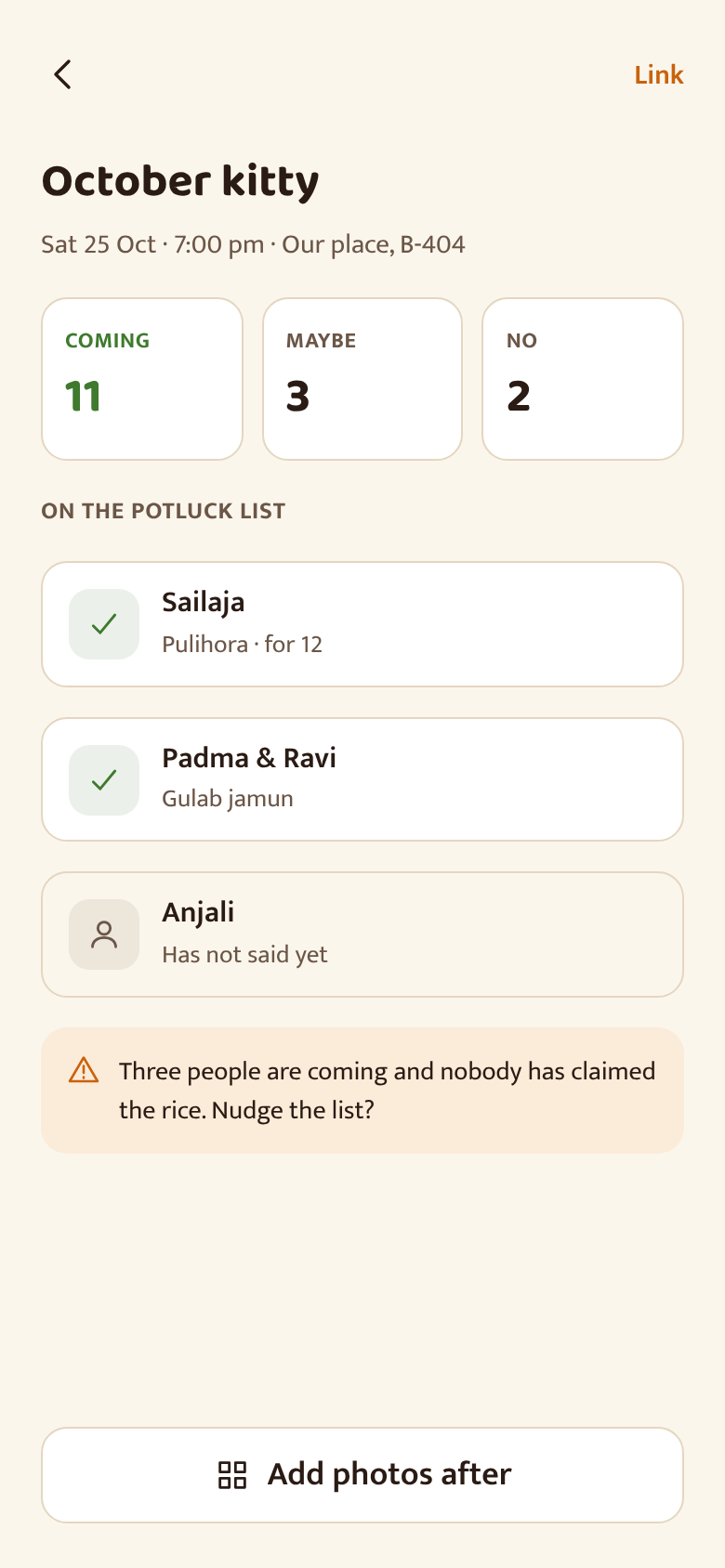
A kitty. Amma’s birthday. A housewarming, a satyanarayana puja, a potluck for
New Year. The same app, with everything the committee needs switched off.
A real headcount, instead of counting a WhatsApp group twice and
still getting it wrong.
Who is bringing what, so nobody turns up with a third pulihora.
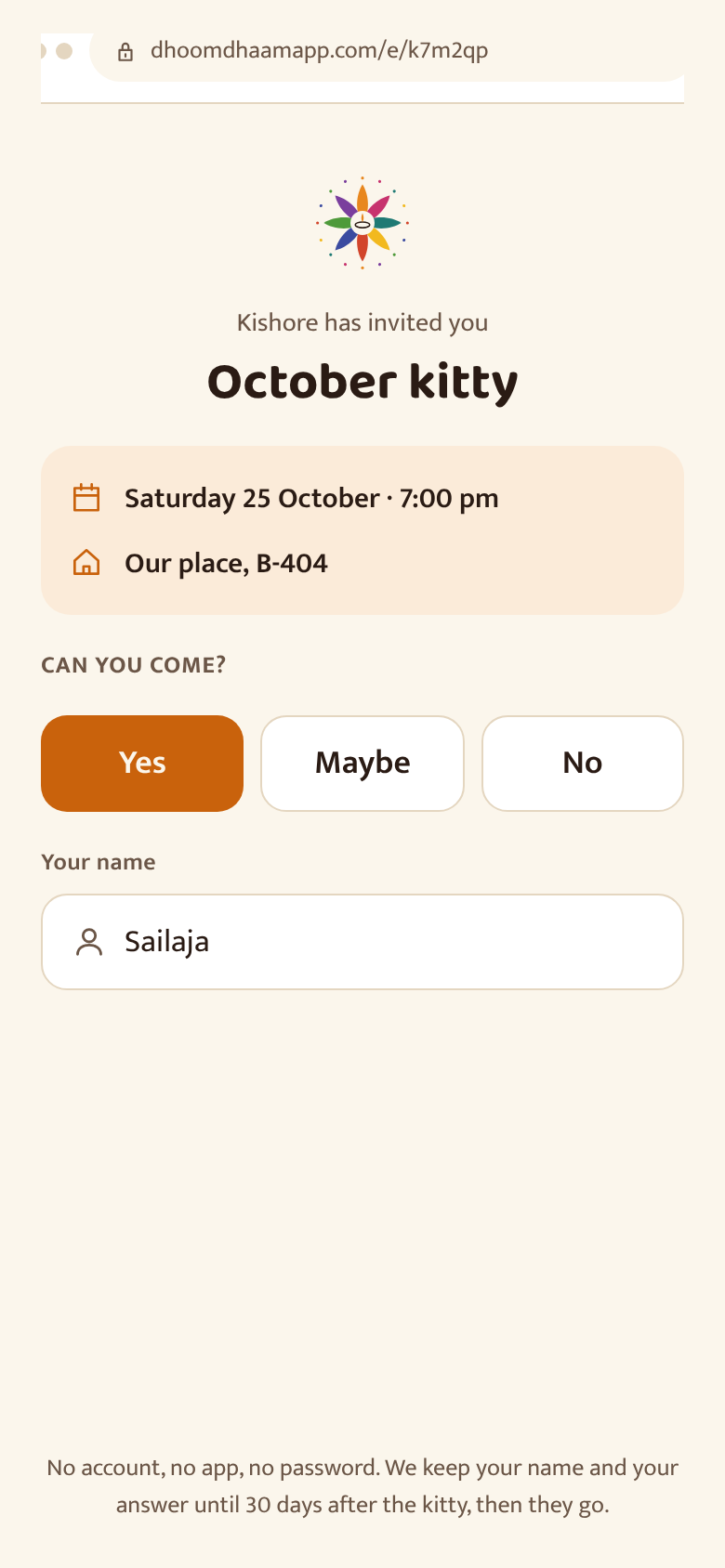
Your guests need nothing. They open a link in their browser and
reply. No app, no account, no password.
We never ask for your friends’ numbers. You get a link and
send it yourself, from your own WhatsApp.
The photos afterwards in one place, rather than seven chats.
Your community does not have to be on DhoomDhaam for any of this — most people
start here. And your own events stay yours: the committee never sees that you had
eleven people over on Saturday.
The obvious question
So who pays for it?
Not your community
No licence, no per-flat fee, no premium tier, and no percentage of what you collect.
A committee member built this because his own society needed it.
Local sponsors, later
The sweet shop, the gym, the tuition centre — the ones who already want a banner at
your pandal. They pay to be shown in the app during your festival.
And never from the pot
Sponsor money is separate money. What residents give is counted, published and spent
by your committee. We are not a party to it.
Get your community on it
We set each community up by hand, after a word with the committee — that is what stops
anyone collecting money in your society’s name. Tell us where you are and we will
come back to you.